Physical Address
304 North Cardinal St.
Dorchester Center, MA 02124
Physical Address
304 North Cardinal St.
Dorchester Center, MA 02124

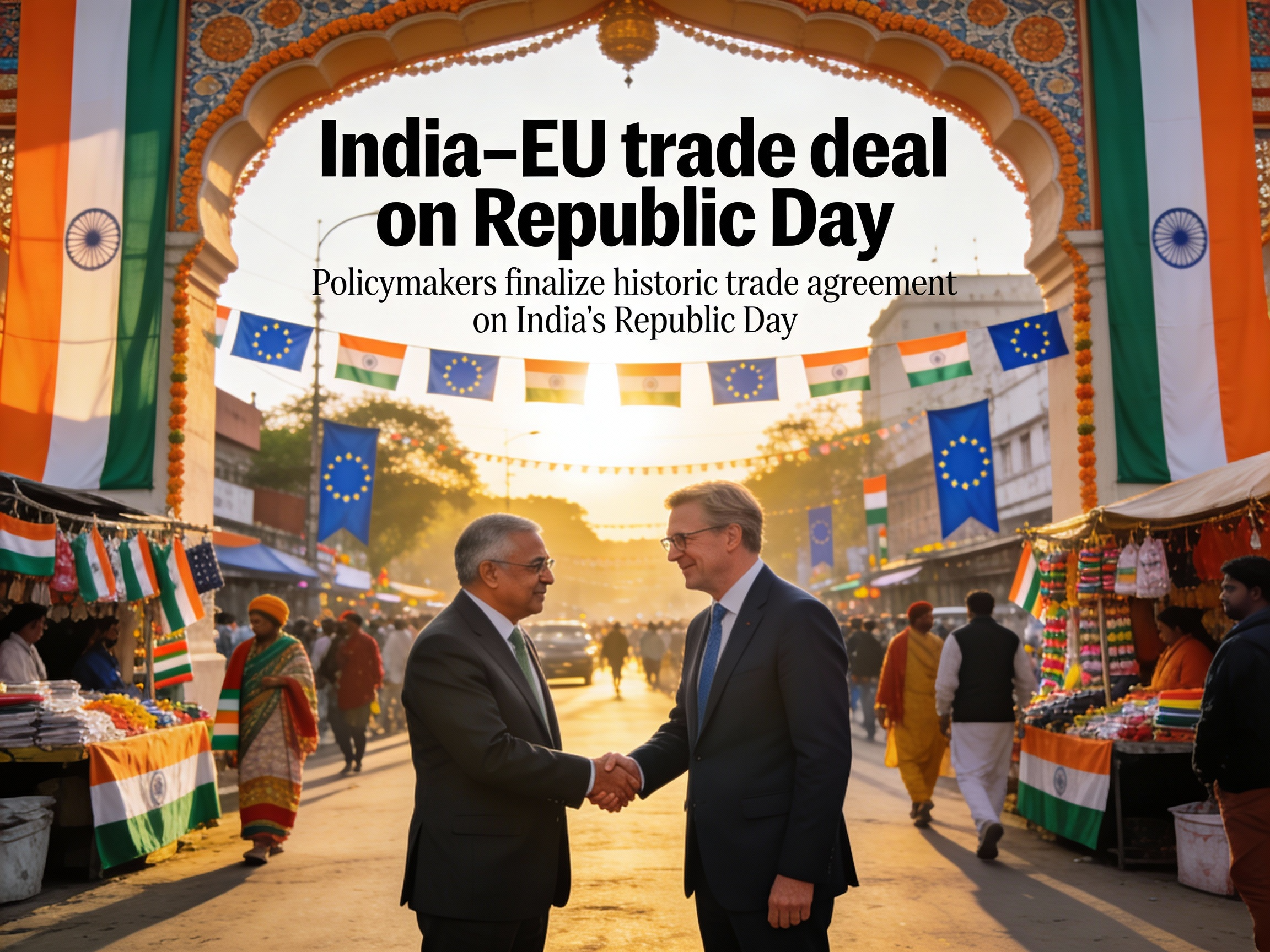
On January 27–28, 2026, the Republic of India and the European Union (EU) reached an unprecedented Free Trade Agreement (FTA) — heralded as a transformative moment in global trade history. The deal was celebrated during India’s Republic Day festivities, with high-profile leaders including Prime Minister Narendra Modi, European Commission President Ursula von der Leyen, and European Council President António Costa attending events in New Delhi to mark the occasion.
This landmark agreement — often described as the “mother of all deals” — culminated nearly two decades of negotiation and now sets a roadmap for reshaping trade relations between two of the world’s largest economic powers.
In this detailed article, we will unpack the history, key provisions, economic implications, geopolitical impact, sector-wise analysis, and future roadmap of the India-EU Trade Deal 2026 — in a manner that’s informative, engaging, and SEO-optimized for maximum discoverability.
At its core, the India-European Union Free Trade Agreement (India-EU FTA) is a comprehensive trade pact designed to eliminate or reduce tariffs on a wide range of goods and services, enhance market access, and build regulatory cooperation between India and the EU.
This agreement was formally concluded at the 16th India-EU Summit in New Delhi — coinciding with diplomatic visits and India’s Republic Day celebrations — highlighting its symbolic and strategic significance.
Key features include:
Together, India and the EU represent around 25% of global GDP and nearly one-third of global trade, making this pact one of the most economically consequential deals of the decade.
Also Read: How AI Automation Will Transform Export Trade By 2026
Long before 2026, free trade discussions between India and the EU began as early as the 2000s, aiming to forge a deeper economic partnership rooted in mutual interest. Over nearly 18–20 years of negotiations, both sides engaged in persistent dialogue covering goods, services, investment, regulatory cooperation, and market access.
The decisive breakthrough came at the 16th India-EU Summit in New Delhi. With leaders gathering as part of India’s Republic Day celebrations, both sides announced the conclusion of the India-EU Free Trade Agreement.
This summit underscored a pivotal shift in global economic alliances, in the backdrop of ongoing trade tensions, geopolitical uncertainty, and evolving supply chains — emphasizing the importance of resilient trade partnerships for future prosperity.
This India-EU Trade Deal is expected to trigger far-reaching economic impacts across industries, regions, and supply chains. Let’s explore the most important ones:
The agreement is projected to significantly increase bilateral trade between India and the EU — potentially expanding trade volumes from the $136 billion range in 2025 to nearly $200 billion by 2030.
This surge is driven by:
India’s export sectors are expected to benefit massively:
Many of these sectors will receive immediate duty eliminations or preferential access to EU markets.
Trade bodies and industry associations have lauded the deal as a catalyst for doubling export value in select segments within the next few years.
By reducing export barriers and tariffs, the deal is poised to:
A diversified trade base helps reduce systemic trade risks and encourages long-term industrial growth
The trade pact is not just about exports and tariffs — it’s also about livelihoods.
By boosting demand for Indian goods and services, especially from micro, small, and medium enterprises (MSMEs), it’s expected to generate employment and scale opportunities in traditionally underserved sectors.
Consumers on both sides stand to benefit from more affordable imports:
It’s a classic win-win scenario: increased variety at decreased costs.
The India-EU Trade Deal carries significance beyond economics. It is a geopolitical pivot, shaping new alliances in a rapidly changing world order.
The pact comes amidst rising international trade tensions — particularly with the United States and China. Both India and the EU have faced tariff disputes with the U.S., making bilateral ties a way to diversify economic dependencies.
The signing at Republic Day celebrations — a national symbol of India’s democratic and economic aspirations — was a powerful diplomatic gesture that reinforced India’s role as a key global partner.
With such a large combined market — nearly two billion people — the pact sets a precedent for future trade frameworks, influencing norms around:
Countries around the world are watching closely.
The India-EU Trade Deal signed around Republic Day 2026 marks a decisive turning point for India’s export-import ecosystem. By unlocking preferential access to one of the world’s largest and most stable markets, this agreement fundamentally strengthens India’s position in global trade. For exporters, especially across textiles, engineering goods, gems and jewellery, leather, and MSME-driven sectors, the deal opens a clear pathway to higher volumes, better margins, and long-term demand stability. Reduced tariffs, simplified compliance, and predictable regulations directly improve India’s export competitiveness in the European Union.
On the import side, India gains access to advanced European technology, machinery, automobiles, and green solutions at lower costs—supporting domestic manufacturing, infrastructure growth, and innovation under initiatives like Make in India. More importantly, this trade pact helps India strategically diversify away from over-dependence on a few markets, making its export-import framework more resilient to global shocks.
The broader verdict is clear: this is not a short-term trade boost, but a structural upgrade of India’s foreign trade architecture. As India and the European Union deepen economic trust, India’s export-import market stands to become more balanced, future-ready, and globally influential.
Reach us on Linkedin: Linkedin Link
Contact Us: To Start a Trade
Hashtags: #IndiaEUTradeDeal #IndiaExports #GlobalTrade #RepublicDay2026 #ExportImport #TradeImpact
SEO Keywords: India EU Trade Deal, India export import market, India EU FTA impact, Republic Day trade agreement